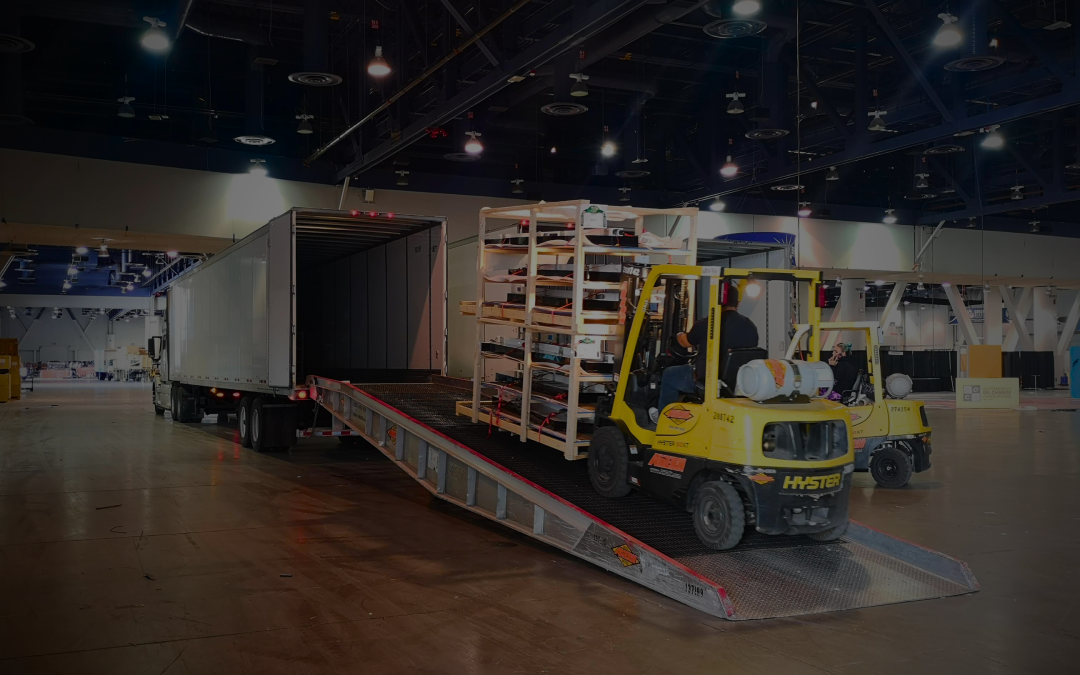
When walking a tradeshow floor or filing into a concert venue, it’s easy to get lost in the polished exhibits and stage lighting. To most people, the event appears to materialize overnight. What they don’t see is the 48 hours before doors opened: hundreds of trucks staged at a marshalling yard miles away, freight brokers fielding calls, union labor crews working on their own clock, and a coordination chain where a single misstep can cost an exhibitor thousnads of dollars or delay an entire show.
Live event freight operates under a different risk profile than standard retail or industrial shipping. These loads don’t move to a warehouse dock on a flexible schedule, they move to a convention centre or venue on a hard deadline, in a high-pressure environment, with layers of moving parts that all must work together perfectly.
The Clock is Always Ticking
At a tradeshow, deadlines aren’t suggestions. Each exhibitor is assigned a specific window to receive their freight, and missing that window doesn’t just cause delays, it causes loss of money and resources.
Account Manager, Josiah Freeman states, “[One of the biggest headaches is] deadlines and driver efficiency. If carrier companies misrepresent their capability to check in for a live event within the window, it costs the customers thousands. Also, if they don’t correctly check in the same thing happens!”
This is what separates live event freight from everyday shipping. A carrier that overpromises their on-time capability, or a driver that messes up their check-in process can put the entire timeline of an event in jeopardy and leave the customer holding a bill for thousands of dollars in penalties. This is why carrier vetting is so important.
The Marshalling Yard
One of the most overlooked realities of live event logistics is the marshalling yard. Rather than pulling directly to the convention centre or venue, trucks are staged at a designated lot, sometimes miles away, and dispatched to the venue in controlled waves as dock space opens. It’s an organized system, but it comes with a significant catch, the wait.
Executive Account Manager, Chandler Raiden says, “A lot of times if the show or event is running behind, they could have to wait for a really long time. We do compensate the drivers however sometimes they feel it is not worth the time/money and will just leave and fall off the load.”
A driver deciding to leave mid wait is a real risk. This is why it’s important for brokers to counter this by locking in expectations before the load is booked. This looks like being transparent about wait times, and whenever possible, establish a direct line to an on-site contractor who can help get the truck dispatched faster. That direct relationship with the venue can be the difference between a driver who stays on the load and one who doesn’t.
Communication is The Job
If there is one thing that defines live event freight, it’s the relentless communication required to move a shipment from point A to point B without anything going wrong.
Account Manager, Jacob Clark says, “I am speaking with the [driver] about two hours before check-in time, providing updates and ETA, through the truck being unloaded. So check-in, once they’re dispatched from the marshalling yard, once they are in line at the docks, once they dock, and once they begin unloading. The better the relationship with your customer, the less you have to say. My customers know at this point that no news is good news.”
The communication goes beyond just the customer, broker, and driver. Venue coordinators are often understaffed, working a check-in desk with one or two employees managing a flood of inbound trucks. Drivers who can’t clearly communicate the exhibitor they’re delivering for, or who don’t understand the check-in process, create bottlenecks that mess with the entire schedule.
What No One Can Control: Union Labor
Even when all of the pieces are fitting and execution is perfect, there’s one variable that can stop everything: union labor rules.
Clark says, “A driver can check in at 6AM, wait until 6PM, and if the union stops working, that driver will sit until the next day. It doesn’t matter who you call, how much you paid, it is what it is and they just print money while leaving you completely tied.”
Union crews operate on strict schedules, and when their shift ends, freight movement stops.
Why Experience Matters in Event Freight
Live event and tradeshow logistics require a different approach than standard freight. The stakes are higher, the timelines are tighter, and the variables (marshalling yard, union labor, venue coordinators, and driver communication) are unlike anything in typical trucking.
At Freeway International Logistics, we’ve navigated all of it. With a team built on transparency, carrier experience, and real time communication, we know how to vet carriers who can actually handle the pressure, prepare drivers for what they’re walking into, and maintain the coordination that keeps a shipment on track from the marshalling yard to the dock. And with GPS tracking on every FTL load, our customers always know where their freight stands, no chasing down updates, no guessing. Your event has enough moving parts. Let us handle the freight. Contact the Freeway team today.
Written by:
Hollis Tate | Freeway 2026 Account Manager Intern | Student at Auburn University |